Showing posts with label carnival. Show all posts

Sunday, June 22, 2014

Chein Tin Toy Ferris Wheel

The outdoor antique show season has finally begun in our northerly part of the world. At the first show on our annual agenda, we found this great old tin toy ferris wheel, 16 inches tall, still in working order. When the key is wound, the wheel spins and the bell rings repeatedly (and loudly.)


Made of lithographed tin by the J. Chein Company of New Jersey in the 1930s, this ferris wheel became one of the long-lived firm's most classic and collectible toys. Its design evolved over several decades, with different images on the base, including a version with Disney characters made in the 1950s.

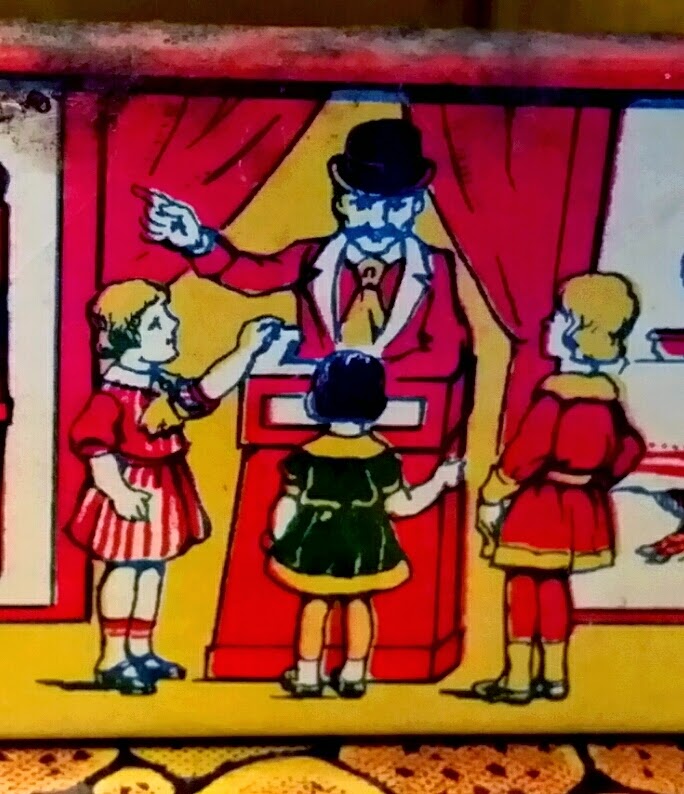
This earliest example has wonderful illustrations of a carnival sideshow on the end panels, and Orangeade and hot dog vendors on the front and back.


Note the Orangeade in its iconic globe dispenser.


The sideshow talker has a somewhat sinister air.

The smiling face in the wheel's center bears the name "Hercules," and this toy is sometimes referred to as the Hercules Ferris Wheel.


It is often found with the mechanism and bell missing, which is unsurprising after hearing how loud it is in operation. I imagine a lot of exasperated parents yanked the bell off after a few days of its ceaseless racket. If you find one in working order, you've found a treasure.


Sunday, July 22, 2012

Crandall's Acrobats, 1867

My birthday last month was one of my happiest ever: I receieved an antique toy that had long been on my "It's Hopeless" wish list, as I had only ever seen it in museums or an occasional high-end auction. But then, just a couple of weeks before the big event, we found one from an online toy dealer, and at a reasonable price.

The toy is now one of the oldest in my collection, and, I think, one of the most beautiful. Patented in 1867 and made throughout the 1870s, Crandall's Acrobats were created by Charles M. Crandall, born in 1833. His business was first located in Covington, Pennsylvania, and later moved to Waverly, New York. He became one of the preeminent American toymakers of the 19th century, specializing in wooden toys, and is now famed for his building blocks, jointed figures, and puzzles.


The Acrobats came in a wooden box with a paper label, which reads:

[Crandall's Building Blocks]
Crandall's Great Show,
THE ACROBATS.
Full of Fun and Frolic, and Most Brilliant in Costume.
Will exhibit at the house of the purchaser Afternoon and Evening.
NO POSTPONEMENT ON ACCOUNT OF WEATHER.
MATINEE EVERY MORNING.
Admission Free, Children Half-Price.
[Patented Feb. 5th, 1867]

 
Inside the box are pieces to make five acrobat figures, comprised of separate torsos, heads, legs and arms. The legs and arms feature hand painted details, while the torsos and heads have beautifully lithographed paper designs, all different, printed on each side of the figure, which doubles the number of combinations possible.


Here are close-ups of some of the heads:


Yes, clowns are scary...this one especially so.

 
The Acrobats feature one of Crandall's most innovative designs: the pieces have slotted sides that  allow them to be connected in a dove-tail fashion. This enabled children to assemble the figures in a variety of combinations.


When assembled, the acrobats stand about eight inches tall:


The set also came with several slotted bases, into which the acrobats could be inserted. Then children could use the enclosed booklet or their own creativity to build acrobatic pyramids.


My set still retained remnants of its original booklet, now in an incredibly fragile state.


I'm off to hold my first matinee, "admission free and children half-price."

Saturday, May 5, 2012

It's Only a Paper Moon Postcard

Old postcards and photographs comprise some of the Other Stuff I collect besides toys. This is a real photo postcard from 1912, sent by a woman named Fannie to her younger sister on September 5. It's one of a type known as "Paper Moon Photo Postcards." These were real photos taken of people using a paper moon backdrop, usually done at fairs or carnivals and sold as souvenirs.

Some fabulous examples of paper moon postcards as well as the lyrics and music to the contemporary song, "It's Only a Paper Moon," can be found at the Daily Postcard site, here.


For some reason, the sender felt it was important to write this woman's weight across the top of the card: 158 1/2 pounds. At least, I'm assuming that's her weight, and not that of her little dog.

Wednesday, September 21, 2011

Carnival Chalkware Prize

This carnival chalkware prize is Bimbo, Betty Boop's doggie boyfriend. Bimbo starred in his own cartoons, with the first appearing in 1930. As Betty's star surpassed his own, he was relegated to boyfriend/sidekick status before disappearing altogether, allegedly due to concerns about the interspecies nature of their relationship...


7 inches tall, circa the 1950s.

Wednesday, April 27, 2011

Antique Carnival Items: Signs, Games, Punks, & More

Hurry, hurry, step right up and see my latest find: a huge lot of antique carnival items!  Most of the pieces are from the 1930s, and have seen heavy use in traveling carnivals. With their handmade nature and patina of age, they have a folk art quality that is very appealing.


First up: this hand lettered wooden sign for a coin toss game,
5 feet long:


Here's a closeup of the hand lettering, 
a fascinating art form:  


And, if you look closely at the "5", you can see where the old price of "10" cents was painted over, I'm guessing during the Depression years.


One of the most unusual pieces in the lot was this gigantic wooden sledgehammer, almost 3 feet tall, with a head a foot wide. The bands around the head are thick steel. It was used in the classic carnival High Striker, or bell ringing game, in which a fair goer would attempt to ring a bell at the top of a tall platform by hitting the base. This hammer is so heavy, I have no idea how anyone would have managed to swing it. I had to drag it up my stairs, stopping for a rest along the way...


One of the most interesting finds was another classic game, the milk bottle knock-down. The 7 inch wooden milk bottles were heavily dinged and scraped from decades of use. The game came with a basket full of its original, accompanying baseballs.


The goal was to knock the 3 bottles over with a tossed ball. It sounds simple, but in actuality, it hardly ever happened. Turning over the bottles reveals why: one has been hollowed out, and a lead weight inserted. The hole was then plugged, and the weight made it very difficult to knock over. In the photo below, the gaffed bottle is on the top of the pile.


Some of my favorite items in the find were an assortment of 3 carnival punks, or knock down dolls. In a game similar to the milk bottles, customers tried to knock the punks over to win a prize. The most common form of punk was a clown with a crazy halo of hair, which was made of wool in the earliest examples, like these 11 inch varieties:


The other punk was very unusual; I've never seen one quite like it. Measuring a very large 21 inches tall, it features a hand painted cat on green canvas, with the word "Lux" prominently spelled out, and yellow tassled fringe adorning the sides. It's a little spooky...


Another big sign, a bit more recent than the first and not as skillfully painted, was this 10 cent candy advertisement:


From a selection of shooting gallery targets, I chose this cast iron duck, 5 1/2 inches wide. Like the hammer shown previously, this target is so heavy, I don't see how it could ever have been successfully struck. Its age, wear, and weathering have given it a wonderful primitive charm.


Also from a shooting gallery came this double squirrel target, made of wood, cast iron, and steel, measuring 7 inches tall by 10 inches wide. It would originally have been one small segment in a wide shooting range composed of many similar pieces. After knocking the squirrels over, a hit on the center white circle target makes them pop back up again.


Here's a closeup of the squirrels, 2 inches tall: 


This last item is a bit more recent than the others, probably from the 1950s. It's another great hand lettered sign, 16 inches wide, most likely from a ticket booth.


It's an incredible feeling to hold these items and imagine the places they've been and the people they've seen...I can almost smell the cotton candy and hear the screams of riders on the roller coaster.
Tuesday, October 12, 2010

King Kong Carnival Chalkware Figure

If you visited the gaming tents of a traveling carnival in the 1930s, and fortune favored you that evening, you could have won this glorious chalkware prize: a 14 inch tall statue of King Kong.


If I'd been at a carnival back then, you can bet I would have been begging my date for one of these. It always amazes me to find such old chalkware pieces in such great condition today, as they are notoriously fragile.

 Grrrowrrr!

Monday, July 12, 2010

Vintage Cracker Jack Prize: Sideshow Panorama

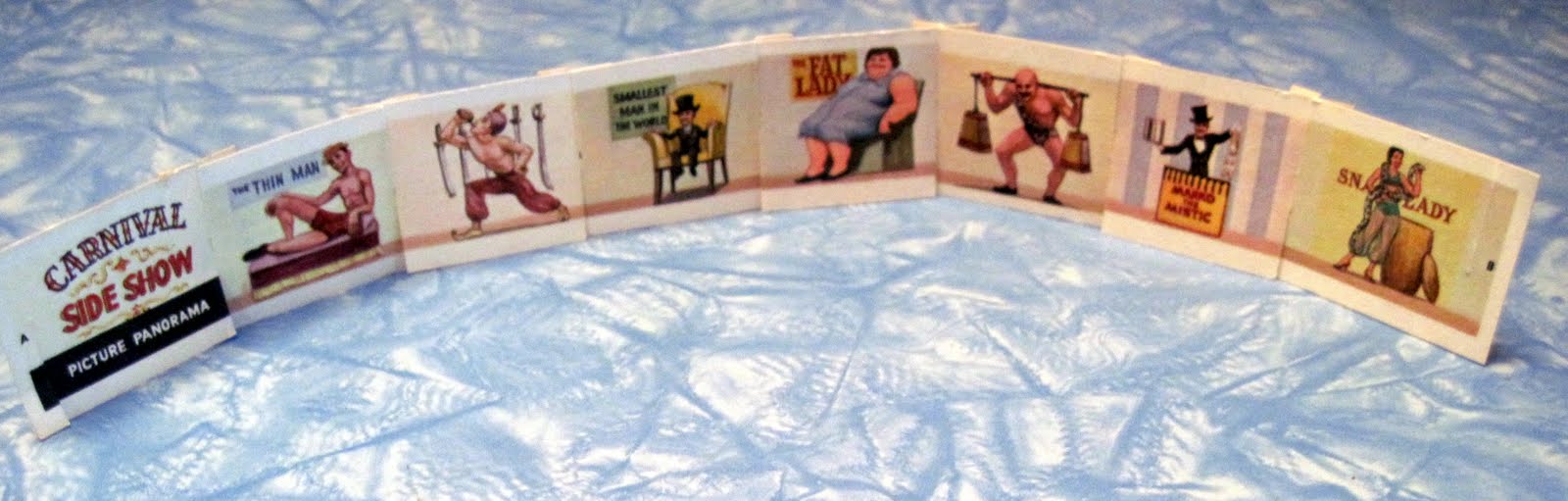
I was fortunate to grow up in the 1970s, the last decade of really good Cracker Jack prizes, before those pesky "safety regulations" took effect. The best Cracker Jack prizes, though, are even older, like this one which dates from around the 1950s. The tiny paper booklet, about the size of a matchbox, separates into individual pictures, which, when connected via tabs and slots, create an astounding carnival sideshow panorama.


The assembled panorama looks like this:


Here are some closeups of the pictures. Each has a description of the performer and some interesting historical information on the back:

All in all, a pretty amazing "free" prize!

Vintage Circus & Sideshow Pop-Up Book

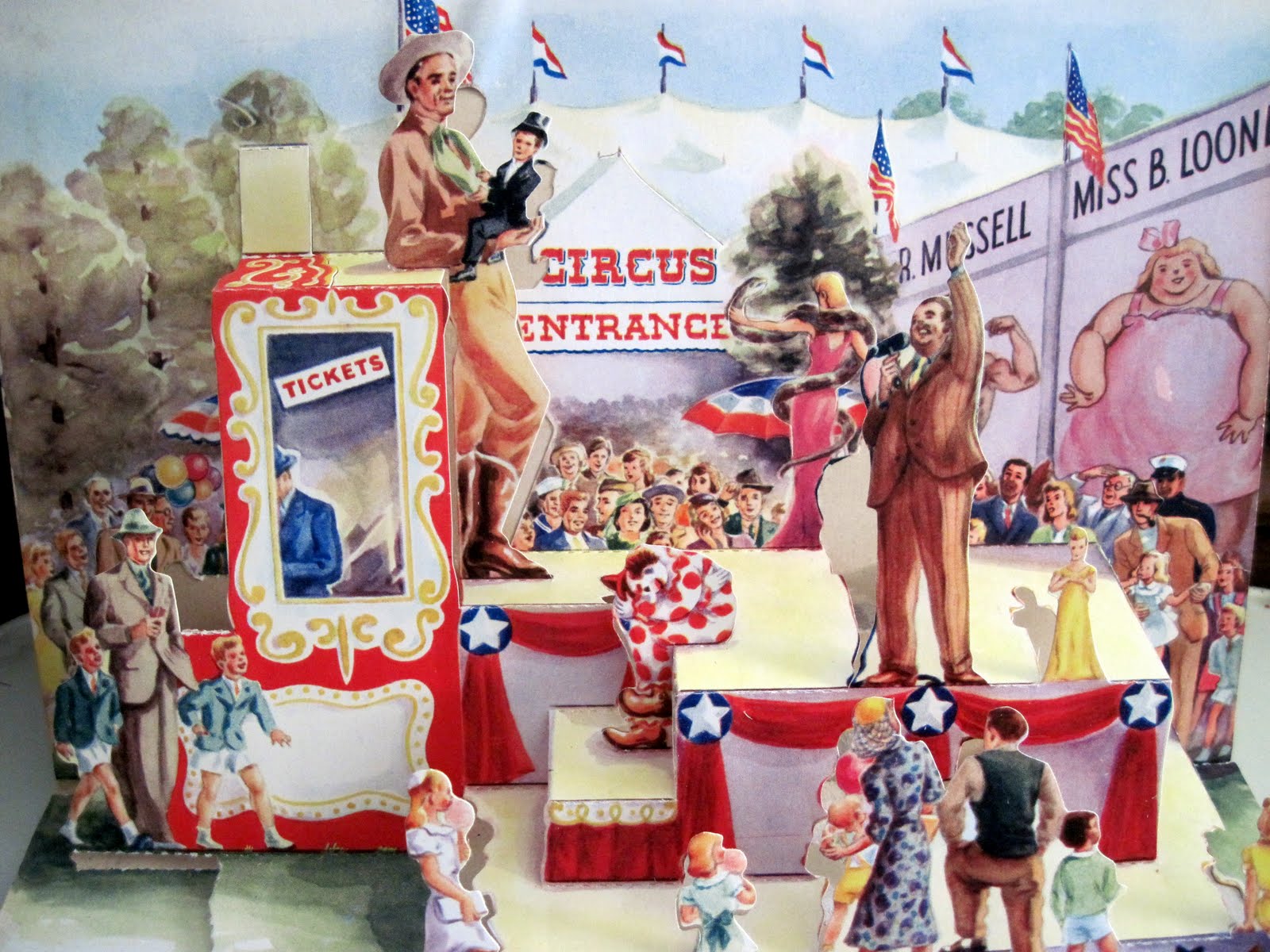
I found this amazing pop-up book last summer. Published in 1944, it features incredible 3-D scenes of a circus, complete with a sideshow. (Oh, how times have changed...can you imagine the freak show spread in a children's book of today?)

Thursday, July 8, 2010

Chein Ferris Wheel

Made in the 1930s by the Chein company, this tin litho ferris wheel is 16 inches tall. The little cars have images of children riding in them, and the center spoke bears the ride's name, "Hercules," along with a fabulous smiling face. This toy just makes me happy whenever I look at it.

 Here it is in its natural habitat, my display of circusy toys.

Wednesday, July 7, 2010

Antique Ten-Pins

I don't know why, but I love old wooden ten-pins. They're just beautiful objects, with their patina revealing their age and use. I cluster them around the house in little groupings, and they just make me smile as they remind me of carnivals and games. These vary in age, with the oldest from the 1900s and the latest from the 1940s, and the tallest is about 6 inches high.

Chalkware Carnival Prizes

I love old chalkware carnival prizes. They're just fun, colorful, delightful objects to have around. These three date from the 1950s, the largest is 12 1/2 inches tall, and they represent a couple of Kewpie-type characters and a circus horse.  And one has a secret...

...the smaller figure wearing the sailor hat has a message penned underneath which reads: "John won this August 27, 1960. Homecoming at Ubly." Ubly is a tiny village in rural Michigan, and for non-American readers, Homecoming is a major high school social event, featuring a formal dance, parties, and, in this case, a carnival. I don't know who John was, but I get the feeling he and the recipient of this prize ended up happily married, as she treasured and saved this for 50 years...

Monday, July 5, 2010

Vintage Carnival Duck Pond Game Pieces

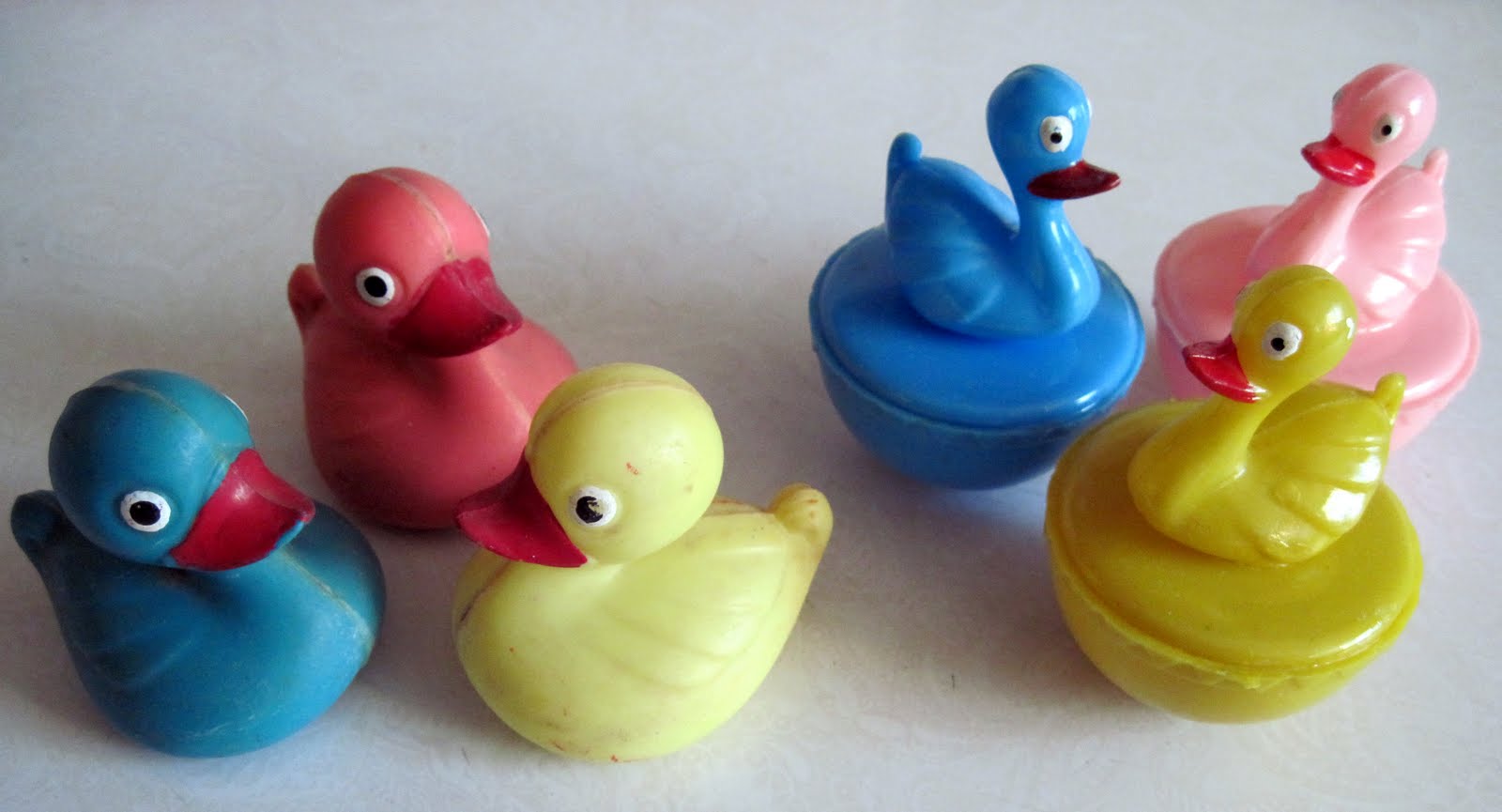
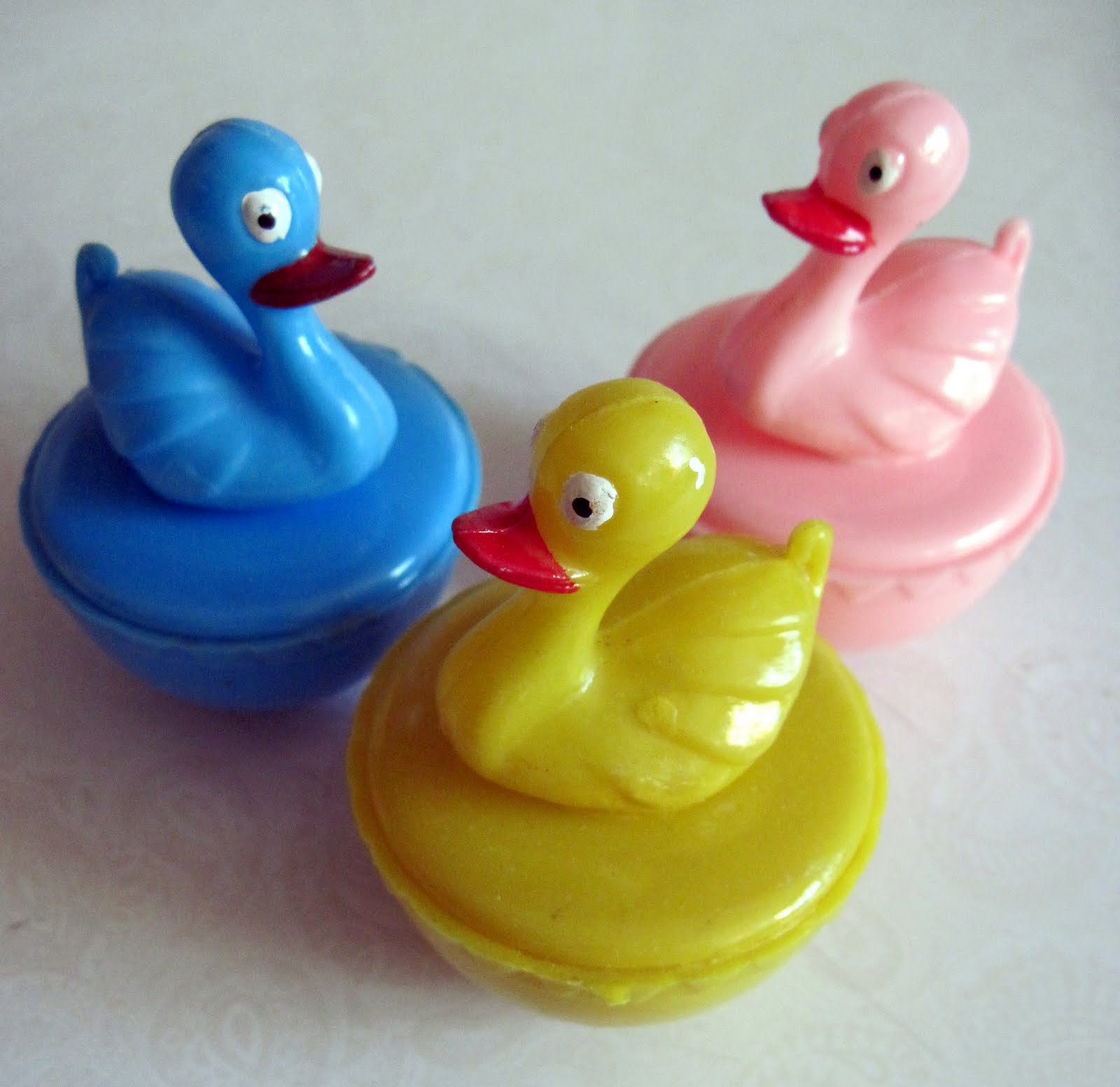
My favorite carnival game of all time is the Duck Pond, because, really, who doesn't like a game where you're guaranteed to win a prize, regardless of your lack of skill? All you have to do is pick up a little plastic duck floating in the artificial pond, turn it over, and the number marked underneath corresponds to the prize you win. Who cares that the prizes are flimsy plastic tchotchkes ordered by the ton: you won something! Yay!

I was very lucky to find some vintage Duck Pond ducks for sale recently. Those on the left are carnival-used, while those on the right, on the bobbing bases, are unsold old store stock.

Aren't they cute?!

These ones, I think, have a rather startled expression on their faces.