Showing posts with label restoration. Show all posts

Wednesday, June 1, 2011

German Dollhouse Pastry Shop Revisited

A few months ago, I posted about an antique German dollhouse pastry shop we restored. I've been fiddling around with it since then, trying to get its accessories just right. One of the things I've added is a tiny table and chair, making a little dining corner. The shop is so big, there's plenty of room, and I think the addition has made it more interesting.


I also added a new shopkeeper, who seems to match the surroundings better than her predecessor:

"Hello dears! What can I get for you? 
The coffee cake is particularly lovely today."


Wednesday, February 16, 2011

1890s German Dollhouse Pastry Shop: A Restoration Project

If you've followed the blog for awhile, you'll  know that I have a thing for antique dollhouse shops. One of the variations I've most longed for was a large-scale, ornate style German model, but when seen, these rare toys were usually priced far out of my price range. 

But then I found this, a big 1890s-early 1900s German dollhouse pastry shop or confectioner's, measuring 23 inches wide and 13 inches tall. As is the case with many old German miniature shops, it had suffered poorly done but well intentioned updates and repairs over the course of its long life.


 In her wonderful book, Doll Kitchens, German author Eva Stille explains that toy kitchens (and by extension their companion pieces, these shops) would be brought down from the attic each Christmastime by parents who would freshen them up with more grocery supplies, a new pie plate or two, and a bright new coat of paint. All winter, the shops and kitchens would entertain the family's children, until, with the warming spring weather, the toys, now depleted of provisions, temporarily lost their interest. They would be packed back up and returned to the attic, as the children moved their play outdoors, only to be brought back down once more, refreshened, and placed under the tree again the next Christmas.

These toys were usually passed down through several generations: Stille gives an example of an 1885 doll kitchen ordered by a wealthy family in Bregenz. The toy was passed down among girls in the family all the way to 1979, when it was bequeathed to the most recent descendant, who was still playing with it at the time of the book's publication in 1988. I've purchased three different antique German dollhouse shops, and each has had evidence of continuous play through at least two generations, with products dating from as early as the 1900s to as late as the 1950s.

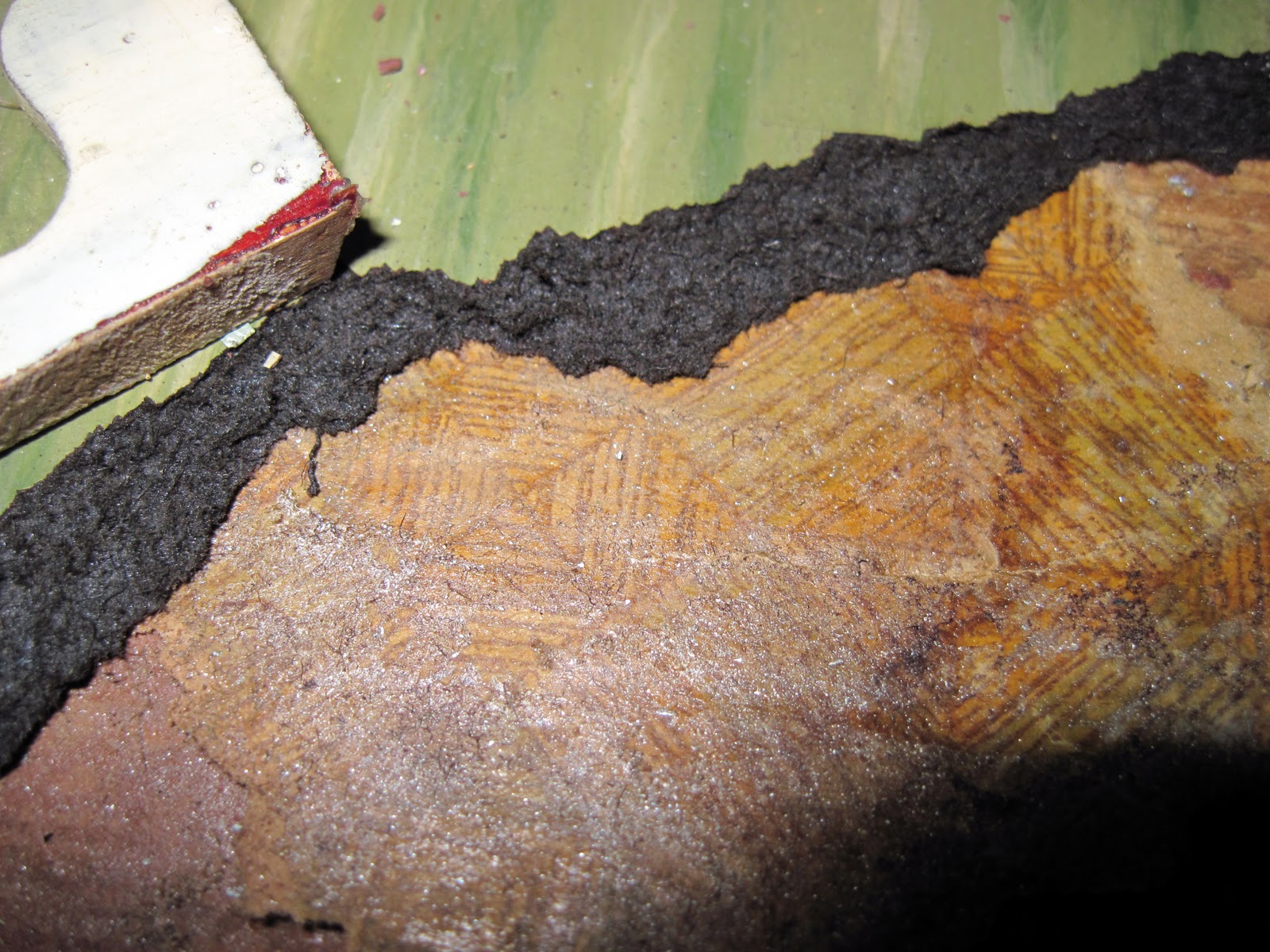
This shop last went through a renovation sometime in the 1930s or early '40s. The original dark red stain, particular to many German dollhouse toys of the early 1900s, had been heavily painted over (sloppily) in green and cream kitchen paint, and the remains of the original paper "wood parquet" floor had been covered with linoleum. Bits of trim had broken off, and been reglued or lost. One decorative front pillar was gone, along with the counter. The lovely, handpainted wallpaper was brittle, stained, and torn, and a modern mirror had been installed along the back wall. An electrified Bakelite doorbell had been screwed in, and to finish off the list of indignities suffered by this once grand toy, an infestation of woodworm had occurred.
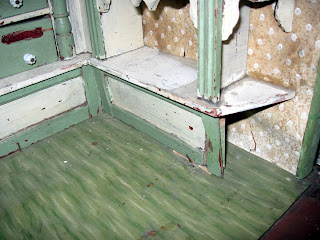


But large swathes of the original red stain were visible underneath the shelves, and much of the trim remained, as did the drawers with most of their porcelain nameplates, tiny handles, and the matching jars. I loved the idea that it appeared to be a pastry shop or something similar, as one of my most fanatical collecting categories is antique dollhouse cakes.

The price was (relatively) low, due to the condition, and my mother, even though she had never done a dollhouse restoration before, was sure she could handle it. And she did. 

First, everything had to be pulled off and out. (My mother recommended I not watch this part, and I agreed. This step was pretty scary.)


Then, the paint had to be stripped, and all the old repairs disassembled.


At this point, we discovered a stamp and some writing on the underside of the shop, but have been unable to decipher them:

I wish I knew what this said...

 I found a replacement counter, and my mom fabricated the missing front pillar and bits of trim. Then she matched the original, heavily varnished red stain finish almost exactly and reassembled the shop shelves.

 Gluing in process.

Finally, we deliberated over the replacement papers. We weren't able to find the same patterns, but when we saw this combination, it just seemed perfect. The papers are reproductions of antique originals, the closest we could get to the real thing.

 Paper installation underway.

And here's the finished shop:


Loaded up with cakes, pies, baking accessories, and a shopkeeper, too:


 Here's a closeup of the lovely shopkeeper. She carries a big spoon, all ready for customers who would like a sample of the many pudding cakes on display:


 All but one of the drawers still have their original porcelain labels. Some are identifiable (cocoa, bonbons, chocolate) while others aren't, at least to me (geh Aepfel? Bucker?) 


 Here are closeups of some of the antique German made cakes, and the very old compote full of wax fruit:


 This tiny cake has "Germany" stamped into one side.


Some of the little accessories include grocery boxes, a tin plate, a copper bowl, and a cake mold:


Here, one of my favorite miniature dollies tries to decide which treat to buy:


Thursday, January 6, 2011

1930s Playskool Pullman

About 25 years ago, when I first started collecting teddy bears, I saw an interesting antique toy mentioned in one of my reference books. In a chapter of hints for displaying miniature bears, the author had posed several tiny teddies in an old tin playset called the Playskool Pullman.

I had never heard of this toy, and I was immediately captivated. The tin Pullman car looked like a miniature suitcase from the outside, and measured 11 1/2 by 9 1/2 inches. A leather carrying handle allowed the owner to easily tote the Pullman along, perhaps on a real train trip. When opened, a miniature train car interior was revealed, complete with a porter's closet, fold-up berth with bedding, and a seating area of benches with a fold-down table. I was absolutely smitten: it was an amazing toy.

It also turned out to be an extremely rare toy. Designed by a preschool teacher in the late 1920s and made around 1930, the Playskool Pullman was reportedly only manufactured for a very brief time, perhaps only a year, before the Great Depression put a stop to the toy's production. For years and years, the Pullman eluded me. With the arrival of internet auctions, I finally saw a few, but the prices were high and the competition was fierce, due to the toy's rarity and crossover appeal to lots of different toy collectors: dollhouse lovers, toy train aficianados, tin toy fantatics, Playskool collectors. But finally, last year, I found one. The good news: it was cheap. The bad news: it looked like it had been sitting in a barn and slowly decomposing for the past 80 years. I bought it anyway, on the assumption that my mom could fix it. She did, and here it is:

Big Bear is running to catch the train, but it looks like he's too late.

Inside, the private compartment is home to 
three little Steiff bears.

The porter's closet on the left was originally intended to hold the mattresses and bedding, but most Pullman owners convert it into a bathroom, as I did with these antique German dollhouse pieces.

The top berth pulls down, revealing a cozy bed complete with 
sheets, blankets, and pillows. 

The littlest bear is tucked in for the night, 
falling asleep to the sound of the train clacking down the tracks.

For comparison, here's what the Pullman looked like when we got it:


Tuesday, September 7, 2010

1916 Hoosier Cabinet

I have a thing for Hoosier cabinets, somewhat strangely I suppose, since I don't cook or spend any time in my kitchen (it's used for displaying my PEZ collection). These cabinets, loaded with specialized compartments for groceries and utensils, were a mainstay in American kitchens from the 1900s through the '40s, and were repurposed as storage units in garages and basements for decades after.

They have appeal to collectors of Americana, and many people remember them fondly from visits to their grandmothers. The cabinets can be things of great beauty, but after years of neglect are often found in this condition:


 My mother and I discovered this Hoosier in an alley behind a Salvation Army store, where it had sat all night in a torrential rain storm.  As apparent in the above photo, it had been badly overpainted many times, and was totally waterlogged. But it still had its original etched glass doors and most of its hardware, and I could tell it was old. We felt it didn't deserve such a miserable end after almost a century of faithful service, and we determined to save it. It took a year of sanding, sanding, endless sanding, but finally it was finished last week. When we cleaned the latches, we found a patent date of 1916, which enabled us to identify the cabinet.

Here it is now, restored to its original golden oak finish:


I use it for storing my vintage board game and puzzle collection, which I imagine the cabinet is really enjoying after all those years of holding greasy tools (we think someone had it in their garage for a long time, after its kitchen duty ended).


The silverware drawer is perfect for small puzzles:


Hoosier cabinets are really fascinating things, and you can learn more about them in a great new book that just came out last year: The Hoosier Cabinet in Kitchen History, by Nancy Hiller.

Sunday, September 20, 2009

Restored Antique Coin Op Horse Kiddie Ride


We finished restoring my antique coin op horsie ride this weekend (for the details, see a few posts down, or click on the "kiddie ride" or "mechanical horse" labels below). Here's video of him in action.

Thursday, September 10, 2009

Restoration: Mechanical Coin Operated Horse Kiddie Ride

I have an amazing mother. She has a gift for repair and restoration, and she can do just about anything: restore a Model T, re-key a vintage gumball machine, reupholster a Victorian sofa, rewire an old lamp, or refinish an antique oak bookcase (all projects she's completed). That she's doing these things in her 60s is even more remarkable to me.

Earlier in the summer, I bought an old coin operated kiddie ride horse at an antique fair. It had been sloppily re-painted in very drab colors, including a heavy coat of black paint over the entire base, and mom was just itching to tackle it. I could see her looking appraisingly at it the first time she saw it, and after that, every time she stopped by, I heard, "You know, I could rewire that thing in a few minutes, and then we wouldn't have to worry about it catching the place on fire when you run it. And, while I'm at it, it would be nothing, nothing, I tell you, to just go ahead, strip it, and repaint it." This went on all summer. Finally last weekend I agreed I was ready to let him go, and before I knew it he was gone, whisked away to mom's workshop of wonders, where he was completely disassembled in mere moments.

Within a day, she had painstakingly stripped all the nasty black repaint off the base to reveal the original colors and even the lettering. The base was originally red with yellow trim and the words "PONY RIDE 5 c" stencilled on the side. It was so exciting to discover this had survived! We debated whether to completely restore the base by repainting and restencilling, but decided to leave it as is, showing all its use and wear. This horse was ridden by a LOT of kiddies back in the day (1940s), as the paint is worn almost completely away on the base top, where they would have been climbing on and off. To me, this wear is an important part of its history, and I enjoy seeing it. How someone could have just slapped all that nasty black paint over it is beyond me...


The next day it was reported that the mechanism had been thoroughly cleaned and regreased. And the rewiring job was finished, complete with a new electrical switch (mom: "like I told you, it took less than 20 minutes!").


Yesterday the primer was applied, and we picked out the paint colors. The first picture below shows the stripped horse, followed by the primer stage. The next picture shows his first coat of paint, and the final image is the finished project. He's a black circus pony now!