It's been a busy summer here, with not much time left for posting my latest finds. In fact, today is really the last day of summer for most people, as schools reopen tomorrow. But today is all about lounging outside and enjoying the sunshine, as Americans flock to beaches and parks for the Labor Day holiday.
And what better way to do that than by banana car? This fabulous 2 foot long ride-on banana was made in the late 1960s - early 70s and sold in grocery stores as a promotional item, along with its partner, the Heinz Pickle car, featured in the previous post.
For another unusual vintage ride-on toy, check out the Mr. Potato Head car.
Showing posts with label odd. Show all posts
Monday, September 7, 2015
Friday, April 10, 2015
Heinz Pickle Ride-On Toy
The winter weather has finally begun to lift here in the north, and that means it's time to get back outside. Let's head out with one of my favorite vintage ride-on toys: the Heinz pickle car.
Made in the late 1960s-early 1970s, the pickle ride-on was apparently a promotional item featured in grocery store displays. Measuring 2 feet long, the sturdy plastic pickle had a companion piece, a ride-on Heinz ketchup bottle, which is even more elusive than this scarcely seen toy.
For another odd vintage toy vehicle, take a look at my Mr. Potato Head ride-on.
Labels:
advertising,
odd,
ride-on toys,
vintage
Sunday, October 19, 2014
Hugo, Man of a Thousand Faces
Presenting one of the creepiest and most unsettling toys ever made: Hugo, Man of a Thousand Faces, released by Kenner in 1975.
Hugo was a 12 inch vinyl puppet/mannequin head who came wearing an artist's smock and with a set of facial disguise accessories. A tube of special glue allowed kids to attach the disguise pieces in a seemingly endless array of combinations, creating a huge variety of characters. A thousand, allegedly.
Children were encouraged to use the disguise pieces on themselves as well as on Hugo, and Kenner suggested Hugo could even serve as a special "friend."
I'm sure Kenner's intentions were good. After all, Mattel's Barbie styling heads had been best-sellers for several years by this point, and little girls across the country were thrilled with the opportunity offered by these playsets to do hair and makeup.
Hugo was a 12 inch vinyl puppet/mannequin head who came wearing an artist's smock and with a set of facial disguise accessories. A tube of special glue allowed kids to attach the disguise pieces in a seemingly endless array of combinations, creating a huge variety of characters. A thousand, allegedly.
![]() |
| These are not the sort of puppet friends you'd find in Mr. Rogers' Neighborhood. |
I'm sure Kenner's intentions were good. After all, Mattel's Barbie styling heads had been best-sellers for several years by this point, and little girls across the country were thrilled with the opportunity offered by these playsets to do hair and makeup.
It must have seemed reasonable to Kenner toy company executives to make a similar product for boys, a mannequin head with accessories boys could use to change the character's appearance. And a spy character with disguises made perfect sense, as it also tied into the popularity of espionage related toys and TV shows of the time. The result, however, was incredibly off-putting, and the finished product now holds a place in toy history as one of the most creepy and disturbing playthings of all time. Take a look:
There's just something unsettling about Hugo: his dead stare; the way he appears to be sizing the viewer up, waiting for just the right moment to begin creeping across the floor towards you; his stare; and again, his stare. Oh, the stare is so unnerving. Just look at it! I can't bear to. As I type this, I have to make sure I can't see that part of the above picture. Let's move on.
Adding the accessories (which include hairpieces, false chins and teeth, fake noses, glasses, scars, warts, an eyepatch, a bandage, and more) doesn't really help. In most cases, it only makes him even creepier.
![]() |
| "I can still see you," says Hugo. |
![]() |
| Suggestions from the box. Shudder. |
The least unnerving version of Hugo I've come up with is this one, which I call Disco Hugo. His crazy 70's sideburns make him somewhat more comical and easier to bear, as long as he's not looking at you directly.
Thursday, December 26, 2013
Mr. Potato Head Ride-On Toy
One of my favorite Christmas presents this year was a long-sought, hard-to-find vintage Potato Head item. From 1973, the Mr. Potato Head Ride-On toy is one of the strangest, and scarcest, items in this long running line.
Measuring 17 inches long, the mobile potato features yellow wheels, a handle, and a seat that lifts up to reveal a storage space for extra face pieces. It comes with two different sets of eyes, ears, noses and lips, along with a hat and glasses, allowing its owner to customize it before taking it for a spin.
Labels:
anthropomorphic,
Mr. Potato Head,
odd,
ride-on toys,
vintage
Sunday, October 20, 2013
Creepy Antique Halloween Squeaker
One of the creepiest antique Halloween items in my collection is this little noisemaker. Circa 1915, it was made in Germany of lithographed cardboard and fragile paper, and is just under 3 inches tall.
The ghoulish face has eyes that move and change when the bellows behind are squeezed. Originally, it would have made a squeaky sound as well, but that part of the noisemaker has long since ruptured.
This squeaker was one from a set of several different faces. Some, like this one, featured moving eyes, while others had tongues that stuck out when the bellows were squeezed.
These white faces represent mangelwurzals, large, beet-like root vegetables used in some parts of the world instead of pumpkins for making jack o' lanterns. There was a similar set printed on orange cardboard representing the more familiar pumpkins.
Some of the other pieces from this set, along with the pumpkin version, can be seen in the books Halloween in America, by Stuart Schneider (page 27 of the 1995 edition) and More Halloween Collectibles: Anthropomorphic Vegetables and Fruits of Halloween, by Pamela E. Apkarian-Russell (page 95.)
The ghoulish face has eyes that move and change when the bellows behind are squeezed. Originally, it would have made a squeaky sound as well, but that part of the noisemaker has long since ruptured.
This squeaker was one from a set of several different faces. Some, like this one, featured moving eyes, while others had tongues that stuck out when the bellows were squeezed.
These white faces represent mangelwurzals, large, beet-like root vegetables used in some parts of the world instead of pumpkins for making jack o' lanterns. There was a similar set printed on orange cardboard representing the more familiar pumpkins.
Some of the other pieces from this set, along with the pumpkin version, can be seen in the books Halloween in America, by Stuart Schneider (page 27 of the 1995 edition) and More Halloween Collectibles: Anthropomorphic Vegetables and Fruits of Halloween, by Pamela E. Apkarian-Russell (page 95.)
Saturday, October 5, 2013
Schoenhut Rolly Dollys
Intended to amuse toddlers back in the 1900s, these roly-poly toys are the stuff of nightmares today.
The Rolly Dollys were a line of simple toys made by the Schoenhut Company of Philadelphia. Founded in 1872 by Albert Schoenhut, a German born toymaker, the firm lasted into the 1930s and was a prominent creator of fine playthings and childrens musical instruments. It is famed today for its toy pianos, Humpty Dumpty Circus playsets, and wooden dollhouse furniture.
The Rolly Dollys first appeared in 1902 and were produced through the 1920s in over 70 different styles. Some were based on advertising or cartoon characters like Buster Brown and Foxy Grandpa, while others represented children, clowns, police officers, and more.
Made of a composition or papier mache type material, the Rolly Dollys are weighted at the bottom so that they spring back upright and then bob comically (or terrifyingly, depending on your point of view) when pushed over. Some have chimes inside as well, producing a delicate tinkling sound (all the better to alert you to their approach.)
This assortment includes a couple of creepy clowns, 5 inches tall, along with a 10 inch comic character, Happy Hooligan, and an unknown terror.
Here's Happy Hooligan, a newspaper cartoon character who first appeared in 1900. In print, he was a cheerful hobo wearing a tin can for a hat, but his Rolly Dolly representation is rather more disquieting. See the original Hooligan and learn his story by clicking here.
This unknown character, also 10 inches tall, sports a pointy hairdo and hypno-eyes, and his hands rest on his distended belly. He has a satisfied smile, as if he's just completed a large meal of small children.
The 5 inch clowns are of the Billiken type. Even with their small size, there's still something vaguely menacing about them, isn't there? Perhaps they should team up with Crandall's Acrobats and put on a spooky sideshow act.
The Rolly Dollys were a line of simple toys made by the Schoenhut Company of Philadelphia. Founded in 1872 by Albert Schoenhut, a German born toymaker, the firm lasted into the 1930s and was a prominent creator of fine playthings and childrens musical instruments. It is famed today for its toy pianos, Humpty Dumpty Circus playsets, and wooden dollhouse furniture.
The Rolly Dollys first appeared in 1902 and were produced through the 1920s in over 70 different styles. Some were based on advertising or cartoon characters like Buster Brown and Foxy Grandpa, while others represented children, clowns, police officers, and more.
Made of a composition or papier mache type material, the Rolly Dollys are weighted at the bottom so that they spring back upright and then bob comically (or terrifyingly, depending on your point of view) when pushed over. Some have chimes inside as well, producing a delicate tinkling sound (all the better to alert you to their approach.)
This assortment includes a couple of creepy clowns, 5 inches tall, along with a 10 inch comic character, Happy Hooligan, and an unknown terror.
Here's Happy Hooligan, a newspaper cartoon character who first appeared in 1900. In print, he was a cheerful hobo wearing a tin can for a hat, but his Rolly Dolly representation is rather more disquieting. See the original Hooligan and learn his story by clicking here.
This unknown character, also 10 inches tall, sports a pointy hairdo and hypno-eyes, and his hands rest on his distended belly. He has a satisfied smile, as if he's just completed a large meal of small children.
This is really not something you'd want watching you while you sleep.
The 5 inch clowns are of the Billiken type. Even with their small size, there's still something vaguely menacing about them, isn't there? Perhaps they should team up with Crandall's Acrobats and put on a spooky sideshow act.
Sunday, February 3, 2013
Mrs. Potato Head, Housespud, in the Biggest All-New Combination Pack
My latest vintage Potato Head set is one of the rarest, and also the largest, with the box measuring in at 18 inches wide by 12.5 tall. That's a pretty big box for a toy that, in the years before plastic potatoes were added, usually consisted of little more than a handful of tiny face pieces.
But the Mr. & Mrs. Potato Head Biggest All-New Combination Pack contains much more than the typical set. In fact, it has everything including the kitchen sink!
Produced for a brief period in the early 1960s, the Biggest All-New Combination Pack was an attempt to accessorize the Potato Heads in a way that would appeal to both boys and girls, and the large box made it appear to be especially deluxe. In reality, the set's accessories were cheaper than cheap, but the cover art really sold it.
The package included not just one vehicle for Mr. Potato Head, and not just a car, like some of his other sets. This one came with a plane, a train, and a boat.
For Mrs. Potato Head, there was a set of gleaming new kitchen appliances, and a baby in a stroller. (More about that baby in a minute...)
Inside, the accessories were tucked into cardboard backers, while fragile styrofoam display heads held the Mr. & Mrs. face pieces. Both the cardboard backers and the styrofoam heads are very easily damaged while trying to remove the pieces, which is probably one reason the set is so scarce today.
Here is Mr. Potato Head's garage. The vehicles are made of a brittle plastic, and the wheels had a tendency to snap off. These are now rarely found intact.
But the Mr. & Mrs. Potato Head Biggest All-New Combination Pack contains much more than the typical set. In fact, it has everything including the kitchen sink!
The package included not just one vehicle for Mr. Potato Head, and not just a car, like some of his other sets. This one came with a plane, a train, and a boat.
For Mrs. Potato Head, there was a set of gleaming new kitchen appliances, and a baby in a stroller. (More about that baby in a minute...)
Inside, the accessories were tucked into cardboard backers, while fragile styrofoam display heads held the Mr. & Mrs. face pieces. Both the cardboard backers and the styrofoam heads are very easily damaged while trying to remove the pieces, which is probably one reason the set is so scarce today.
Here is Mr. Potato Head's garage. The vehicles are made of a brittle plastic, and the wheels had a tendency to snap off. These are now rarely found intact.
This is Mrs. Potato Head's kitchen set. The items are each molded from a single piece of flimsy plastic. They don't have any moving parts, so, for instance, the doors can't open. They are identical to the items found furnishing the metal dollhouses so common in this time period.
And here is the much advertised new baby, in his stroller. He must have been adopted, as he is clearly a human baby, and not a potato. Or perhaps Hasbro didn't want to go to the expense of designing and molding a new potato character, and they just tossed in these cheap dollhouse babies, apparently thinking kids wouldn't notice.
The set comes with instruction booklets for both Mr. and Mrs. Potato Head (and look: there's the human baby right on the cover!) The inside of Mrs. P's gives us a telling glimpse into societal expectations for women at this time:
Yep, that's right: Mr. Potato Head gets to go gallivanting about in his boat, train, or airplane, but Mrs. P. is expected to stay home with her non-functioning kitchen appliances and the freaky baby.
Labels:
anthropomorphic,
kitchens,
Mr. Potato Head,
odd,
playsets,
vintage
Saturday, January 12, 2013
Toy Show Finds
Just got home from one of my favorite vintage toy shows. It's an annual event that happens each January, which really seems like a lousy month for a toy show, coming as it does right after Christmas. This year I planned strategically: when my family asked me what I wanted for Christmas, I said "money for the toy show please!" Here's what I spent it on:
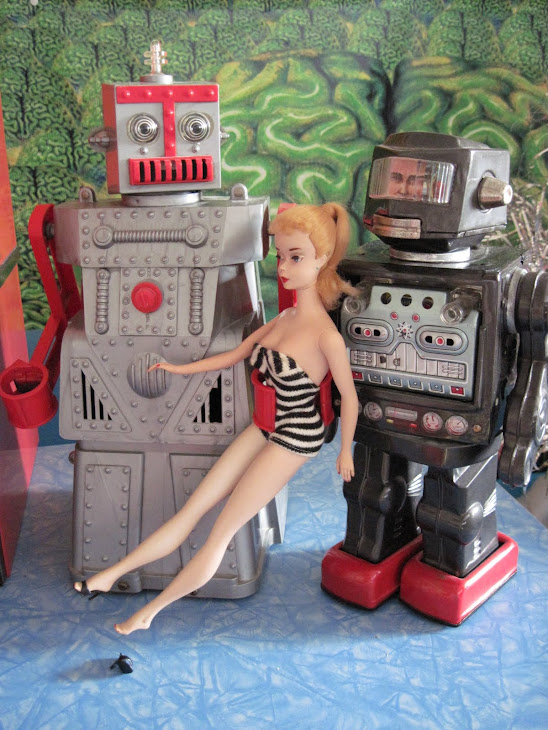
There were all kinds of toy treasures, including a tin litho grocery store playset made in the 1950s by Wolverine; a scarce (and creepy) Hugo, Man of 1,000 Faces from the 1970s; a two-headed Doublenik troll from 1965 along with a tiny vending machine troll; a Weinermobile whistle; a bunch of 1950s space guys; Buck Rogers and Flash Gordon newspaper comics from the 1930s-1940s; a 1960s Batman puzzle; Barbie's original convertible; and a 1950s tin wind-up robot. I'll post properly about them later, but here are some quick pics and sneak peeks.
The robot has some rust, but he also has lots of character.
Hugo, Man of 1,000 Faces, was a bizarre toy made in the 1970s. It's essentially a creepy looking guy's torso and head, along with a package of "disguise" accessories, including false chins, fake scars and warts, various noses, glasses, an eye patch, and hair pieces. I'm guessing it was inspired by spy films, but who knows. It's weird and now rather rare.
Barbie's convertible, made by Irwin in the 1960s, was her first car.
The two shelf units on either side of this tin litho grocery store fold inward to close up the playset. Originally it would also have had a separate counter with accessories like a scale, but these are usually missing. The center span features great imagery of a 1950s supermarket.
The 1930s Buck Rogers newspaper comic above is complete, while the Flash Gordon strips below are only portions (but they feature a fantastic alien giant squiddy monster) :
These two mechanical bears were made in Japan in the 1950s. When wound, the bear on the left turns the pages of his book, while the one on the right wipes his glasses before holding them up to his eyes.
There were all kinds of toy treasures, including a tin litho grocery store playset made in the 1950s by Wolverine; a scarce (and creepy) Hugo, Man of 1,000 Faces from the 1970s; a two-headed Doublenik troll from 1965 along with a tiny vending machine troll; a Weinermobile whistle; a bunch of 1950s space guys; Buck Rogers and Flash Gordon newspaper comics from the 1930s-1940s; a 1960s Batman puzzle; Barbie's original convertible; and a 1950s tin wind-up robot. I'll post properly about them later, but here are some quick pics and sneak peeks.
The robot has some rust, but he also has lots of character.
![]() |
| 1950s space guys. |
![]() |
| A Doublenik two-headed troll from 1965, with its gumball prize friend. |
Hugo, Man of 1,000 Faces, was a bizarre toy made in the 1970s. It's essentially a creepy looking guy's torso and head, along with a package of "disguise" accessories, including false chins, fake scars and warts, various noses, glasses, an eye patch, and hair pieces. I'm guessing it was inspired by spy films, but who knows. It's weird and now rather rare.
![]() |
| Hugo, Man of 1,000 Faces with some of his original accessory pieces. |
Barbie's convertible, made by Irwin in the 1960s, was her first car.
The two shelf units on either side of this tin litho grocery store fold inward to close up the playset. Originally it would also have had a separate counter with accessories like a scale, but these are usually missing. The center span features great imagery of a 1950s supermarket.
![]() |
| The iconic weenie whistle. |
The 1930s Buck Rogers newspaper comic above is complete, while the Flash Gordon strips below are only portions (but they feature a fantastic alien giant squiddy monster) :
These two mechanical bears were made in Japan in the 1950s. When wound, the bear on the left turns the pages of his book, while the one on the right wipes his glasses before holding them up to his eyes.
Labels:
Archer Space Men,
Barbie,
Batman,
comics,
dollhouse food,
dollhouses,
grocery,
horror,
miniatures,
odd,
robots,
show report,
space,
teddy bears,
tin toys,
trolls,
vintage
Saturday, July 28, 2012
Antique Bear & Badges: Mr. Oddfellow
I've posted once before about this bear, shortly after I found him, but he's had a lot of work done since then and I thought he was worth another look. One of the favorites from my collection, this large, 20 inch British bear dates from around 1915, and came wearing an antique child's coat of cranberry colored wool. His original owner had added a few school pins to the coat, including a prefect's badge and what might have been a track and field medal.
I added an old Oddfellows pin, given that the bear has a rather odd, yet endearing, appearance. At some point in his long life, he experienced eye replacement surgery, and apparently his doctor was all out of matching shoe buttons. I wouldn't change it though: the mismatched eyes give him great character.
Anyway, every time I'm antiquing I keep an eye out for more badges for Oddfellow's coat. Here's what he has so far:
Some of my favorites are in this closeup: another Oddfellows badge, a "23 Skidoo!" pinback from the 1920s, and a teeny tiny Charlie McCarthy.
Vintage pins, including a University of Michigan football badge, an old State Fair souvenir, and a Heinz Pickles advertising pin adorn the left side of the coat.
Another favorite, these flight wings were a premium from the Captain Midnight radio show:
I added an old Oddfellows pin, given that the bear has a rather odd, yet endearing, appearance. At some point in his long life, he experienced eye replacement surgery, and apparently his doctor was all out of matching shoe buttons. I wouldn't change it though: the mismatched eyes give him great character.
Anyway, every time I'm antiquing I keep an eye out for more badges for Oddfellow's coat. Here's what he has so far:
Some of my favorites are in this closeup: another Oddfellows badge, a "23 Skidoo!" pinback from the 1920s, and a teeny tiny Charlie McCarthy.
The large Oddfellows badge below dates to the early 1900s.
Vintage pins, including a University of Michigan football badge, an old State Fair souvenir, and a Heinz Pickles advertising pin adorn the left side of the coat.
Another favorite, these flight wings were a premium from the Captain Midnight radio show:
Labels:
advertising,
antique,
ephemera,
odd,
premiums,
teddy bears
Subscribe to:
Posts (Atom)


